 Elvantis
Elvantis
Elvantis
Industrial AI is moving from pilot projects to production lines, where downtime has a visible cost. IDC’s 2024 Worldwide AI and Generative AI Spending Guide forecast global AI spending to reach $632 billion by 2028, including hardware, software, and services. That figure covers more than industrial servers, but it signals growing demand for computing capacity. The International Energy Agency’s Electricity 2024 report also warned that data-centre electricity consumption could more than double by 2026, partly due to AI. Efficiency matters. A lot.
Choosing an industrial ai server manufacturer is therefore about more than comparing processor names. A server beside a robotic cell may face dust, vibration, heat, and limited cabinet space. The supplier should explain how its systems handle those conditions, support accelerators, and connect with factory networks. Ask for tested operating-temperature ranges, power requirements, service intervals, and realistic performance figures for your workload. A glossy peak-performance number is not enough.
Credible manufacturers provide clear documentation, traceable component specifications, and practical support after installation. They should also discuss trade-offs honestly: a compact edge system may reduce network delays, yet offer less expansion room than a rack server. No single design fits every plant. This deserves a second look. Buyers should verify claims against independent test results and their own operating conditions, rather than treating a product sheet as proof. That careful comparison helps turn AI hardware into dependable infrastructure—not just another machine in the server room.
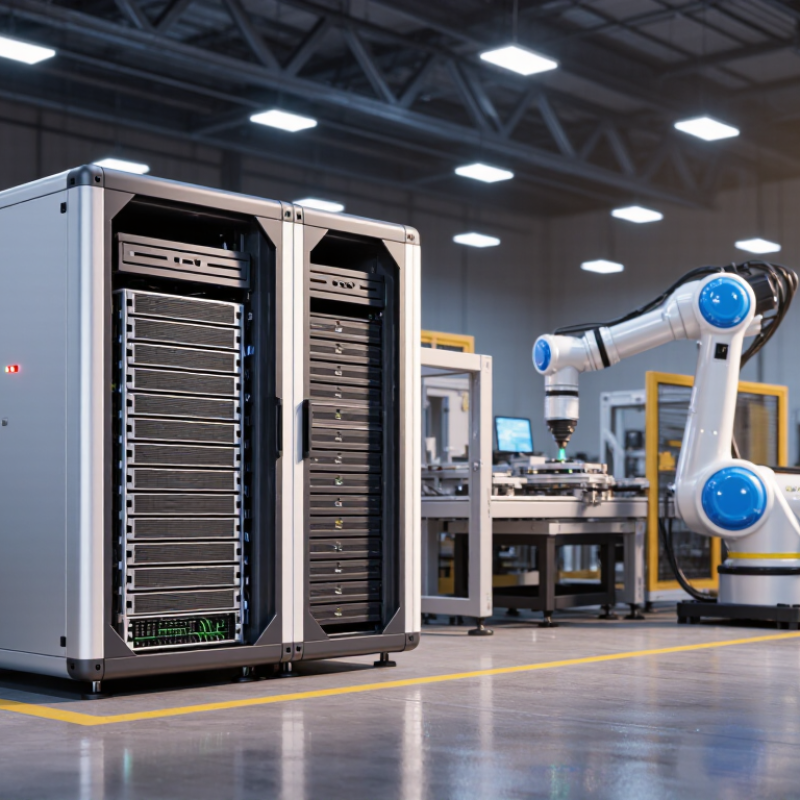
An industrial AI server manufacturer is defined by how well it adapts computing hardware to demanding operating conditions. Factory floors may expose servers to vibration, dust, heat, and continuous workloads. A capable manufacturer considers these conditions during system design, not after installation. Details matter.
That work includes selecting processors, accelerators, memory, and storage that fit the intended AI tasks. It also means checking airflow, power delivery, mounting options, and access for maintenance. Thermal testing under sustained load can reveal problems that a brief startup test misses. Real deployment feedback matters, too, because actual equipment rooms rarely match laboratory assumptions exactly.
A reliable manufacturer documents performance limits and explains how systems are tested. It should offer practical guidance on integration, remote monitoring, spare parts, and service expectations. These details help engineering teams assess whether a server can support their workload over time. Claims alone are not enough. Sometimes a standard configuration is the better choice; sometimes it is not. The right answer depends on data volume, site conditions, and the cost of downtime. A manufacturer that discusses trade-offs openly is easier to evaluate than one promising a perfect fit.
| Evaluation Dimension | What an Industrial AI Server Manufacturer Should Address | Evidence to Request | Why It Matters |
|---|---|---|---|
| Environmental suitability | System configuration should match the installation environment, including operating temperature, dust exposure, vibration, humidity, and available airflow. | Product specifications stating environmental limits, enclosure details, cooling requirements, and applicable test reports. | Industrial sites can have harsher conditions than typical office or data-center environments. Suitability depends on the specific deployment conditions. |
| AI workload configuration | The manufacturer should help size the CPU, GPU or other accelerator, memory, storage, and network interfaces for the intended inference or training workload. | Configuration options, supported accelerator details, power budgets, and workload or benchmark results with test conditions disclosed. | AI performance varies with model, batch size, precision, software, and thermal limits; a component list alone does not establish real-world performance. |
| Thermal and power design | Cooling and power delivery should be designed for the selected processors and accelerators, with adequate airflow, power capacity, and thermal monitoring. | Thermal design information, power-supply ratings, airflow guidance, and documented operating limits for the proposed configuration. | High-performance accelerators can produce substantial heat and power demand. Poorly matched cooling or power can limit performance or system stability. |
| Reliability and serviceability | The design should support practical maintenance, component replacement, and recovery procedures appropriate to the site and operating schedule. | Service documentation, supported replacement parts, warranty terms, repair process, and details of any validated reliability testing. | Maintenance access and repair arrangements affect downtime. Reliability claims should be evaluated against documented test conditions and service commitments. |
| Long-term availability | For deployments that require consistent hardware over time, the manufacturer should explain product lifecycle planning and how component changes are managed. | Lifecycle policy, product-change notification process, and availability information for replacement parts or equivalent configurations. | Unplanned component substitutions can affect qualification, software behavior, and spare-parts planning in long-lived industrial installations. |
| Software and platform compatibility | The system should support the operating system, drivers, AI frameworks, virtualization tools, and management software required by the application. | Compatibility lists, driver and firmware versions, installation guidance, and a process for handling updates and known issues. | Hardware capability alone does not ensure that an application stack will install, run, or remain maintainable as software changes. |
| Connectivity and integration | Available network, storage, expansion, and I/O options should suit the equipment and data flows in the target environment. | Interface specifications, expansion-slot details, supported add-in cards, and integration guidance for the intended system architecture. | Industrial AI systems often need to connect to existing networks, sensors, storage, or control infrastructure; requirements differ by deployment. |
| Security and manageability | The manufacturer should provide documented firmware-update and system-management practices, with security features selected for the deployment. | Firmware update policy, security feature documentation, vulnerability reporting process, and remote-management capabilities where applicable. | Systems connected to operational networks need a manageable approach to updates, access control, and vulnerability response. |
| Customization and validation | Configuration changes should be reviewed and tested as a complete system, not treated as interchangeable parts without compatibility checks. | Configuration records, validation procedures, acceptance-test options, and clear documentation of deviations from standard builds. | Changes to accelerators, memory, storage, firmware, or cooling can affect compatibility, power, thermals, and performance. |
| Technical support | Support should cover the system configuration and clarify responsibilities when hardware, firmware, drivers, and application software interact. | Support scope, escalation process, service hours, response commitments, and procedures for diagnosing system-level issues. | Clear ownership can shorten troubleshooting when problems span multiple layers of the AI server stack. |
It adapts computing hardware to factory conditions, including vibration, dust, heat, and continuous workloads. Practical limits matter.
Consider cabinet temperature, dust exposure, vibration, available power, and space for airflow. A welding area can be especially demanding.
Request sustained-load results with temperature and power measurements. A quick startup test may miss thermal problems.
Confirm support for the required accelerators, memory, and storage. Check camera, sensor, PLC, and network compatibility, too.
Ask for comparable deployment data or a pilot test. Review latency, uptime, and performance after thermal throttling.
Technicians may have a short service window and wear gloves. Check access to cables, mounting points, and replaceable parts.
Request firmware settings, cable requirements, mounting clearances, and recovery steps. Records help separate hardware issues from network problems.
Use a sample workload and measure temperatures after hours of operation. Site conditions can still surprise you.
Clarify who handles troubleshooting and replacement parts. A polished specification sheet cannot answer every field question.
Choosing an industrial ai server manufacturer means selecting a partner that understands the demanding conditions of industrial computing. Unlike standard systems, industrial AI servers are designed to handle continuous workloads, challenging environments, specialized connectivity, and deployment constraints. A capable manufacturer can provide suitable processors and accelerators, memory and storage configurations, thermal management, expansion options, and integration support matched to the intended application.
Manufacturer expertise also helps organizations assess reliability, validate system performance, and plan installation, maintenance, and future upgrades. These considerations matter in settings where dependable operation and timely data processing are essential. Specialized industrial AI servers can support applications across manufacturing, energy, transportation, healthcare, and other sectors that use AI for tasks such as inspection, monitoring, automation, and analysis. By aligning technical capabilities with real operating requirements, organizations can make more informed choices and build systems suited to long-term use.
