 Elvantis
Elvantis
Elvantis
China’s artificial intelligence infrastructure is moving from experimental clusters toward everyday production. Training large language models, processing medical images, and serving real-time recommendations all require dense computing, fast networking, and dependable cooling. This makes the data center ai server manufacturer an increasingly important technology partner, not merely a hardware supplier.
Industry data shows why this market deserves careful attention. TrendForce projected global AI server shipments to grow by about 28% in 2025, supported by stronger accelerator demand and expanding cloud deployments. IDC’s Worldwide Quarterly Server Tracker also continues to show rising interest in GPU-accelerated systems and high-performance server platforms. Energy efficiency is becoming equally important. The International Energy Agency reported that data centers used roughly 415 terawatt-hours of electricity worldwide in 2024. Its Energy and AI report expects consumption to approach 945 terawatt-hours by 2030. That is a serious constraint.
Cooling matters.
This overview examines ten leading Chinese manufacturers through practical criteria. These include accelerator compatibility, rack-scale integration, liquid-cooling capability, domestic supply-chain depth, software support, delivery experience, and after-sales service. Companies such as Inspur, Lenovo, H3C, Huawei, Sugon, and xFusion demonstrate different strengths across enterprise, cloud, research, and government-related workloads. However, public information is uneven, and vendor claims are not always directly comparable. Therefore, this list should not be treated as a permanent ranking. A strong laboratory prototype may still face difficult field deployment. That weakness deserves recognition. The following profiles provide a balanced starting point for buyers evaluating performance, reliability, energy use, and long-term support.
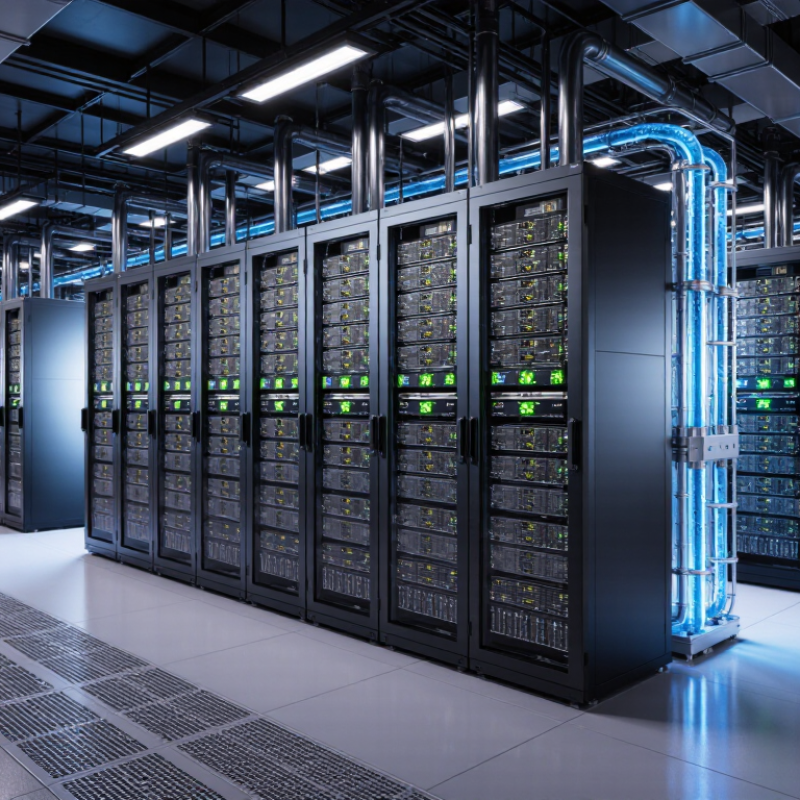
An AI server manufacturer is more than a company assembling racks with accelerators. It designs complete computing systems for training, inference, storage, networking, cooling, and security. China’s data center industry increasingly values integrated engineering, because large models create heavy thermal and power demands. The International Energy Agency reported that data centers used about 460 terawatt-hours globally in 2022. Demand may more than double by 2026.
Performance matters, but it is not the only measure. A credible manufacturer should publish benchmark methods, thermal limits, service response times, and lifecycle costs. The MLPerf benchmark offers useful performance comparisons, although results can vary with software tuning and system configuration. That detail is often overlooked. IDC industry research also tracks China’s rapid expansion of AI infrastructure, showing why supply stability, localized technical support, and long-term maintenance have become purchasing criteria.
Reliability is visible in small details. Engineers examine airflow paths, rack density, power redundancy, firmware updates, and component traceability. Uptime Institute’s survey data places the typical data center PUE near 1.6, reminding buyers that server efficiency affects the whole facility. A strong manufacturer therefore tests systems under sustained workloads, not only short demonstrations. Some evaluations remain incomplete, especially when vendors disclose limited field failure data. Buyers should question polished specifications and request evidence from comparable deployments.
It combines general-purpose processors with specialized AI accelerators. This supports training, inference, storage, and networking tasks. Performance still depends on balanced system design.
High-bandwidth memory supplies large models with data quickly. It can reduce waiting during demanding workloads. Memory shortages may still slow performance at peak times.
PCIe 5.0 links, RDMA networks, and fabric switches reduce server-to-server delays. Hundreds of servers must coordinate closely. One weak connection can leave accelerators idle.
Short tests may not reproduce large distributed workloads. Delays often appear when hundreds of servers train one model. This is easy to overlook.
Direct-to-chip liquid cooling removes heat more effectively than traditional air systems. It supports denser racks and may reduce electricity use. Water management remains important.
Container orchestration organizes workloads across available resources. Model quantization can reduce computing demands. Real-time monitoring may reveal failing components earlier.
Compare performance per kilowatt, not only peak speed. Test sustained workloads with real software, networking, and cooling. Peak numbers can mislead.
Inspect sensor placement, maintenance procedures, support response, and upgrade paths. Check filters and power delivery regularly. Small faults matter. A powerful server may still underperform.
China’s data center AI server industry is defined by manufacturers that combine high-performance computing, scalable system design, reliable supply chains, and strong support for enterprise and cloud workloads. This overview explains how a data center ai server manufacturer develops platforms using advanced processors, accelerator cards, high-speed networking, efficient cooling, intelligent power management, and software designed for large-scale model training and inference. It also highlights the engineering, testing, and service capabilities needed to meet demanding data center requirements.
The article presents a structured review of China’s top 10 data center AI server manufacturers without focusing on brand promotion. It compares their approaches to computing performance, energy efficiency, customization, deployment flexibility, technical support, and total operating value. It also examines major market trends, including growing demand for generative AI infrastructure, liquid cooling, modular data centers, domestic technology development, intelligent monitoring, and more efficient resource management. Together, these topics provide a clear understanding of the competitive landscape and future direction of China’s AI server market.
