 Elvantis
Elvantis
Elvantis
The global AI server market is entering 2026 with strong demand, but purchasing decisions are becoming less straightforward. TrendForce projected AI server shipments would grow by about 28% in 2025, driven by hyperscalers and expanding enterprise deployments. IDC also expects worldwide spending on artificial intelligence systems to continue rising sharply through 2028. These figures show momentum, not guaranteed returns. Forecasts can change quickly when GPU supply, energy prices, or export rules shift.
For global buyers, the right ai server manufacturing company must offer more than powerful accelerators. It should provide validated GPU configurations, high-speed networking, liquid or advanced air cooling, reliable firmware, and responsive regional support. Gartner’s infrastructure research repeatedly highlights operational efficiency, scalability, and total cost of ownership as critical technology-buying concerns. A server that looks impressive in a showroom may become expensive beside a hot rack, limited power capacity, and delayed replacement parts. Small details matter.
Jensen Huang, NVIDIA’s founder and CEO, has described AI as “the most consequential technology of our time.” His statement reflects the market’s urgency, but urgency can also encourage careless buying. This guide compares leading manufacturers through practical evidence, including product architecture, manufacturing capability, service coverage, energy efficiency, and deployment experience. Some rankings remain debatable. That is useful. Buyers should question marketing claims, request test results, and examine warranty terms before signing contracts. The strongest global supplier is not always the largest name. It is the partner that can keep demanding AI workloads stable, serviceable, and financially defensible across real operating conditions.
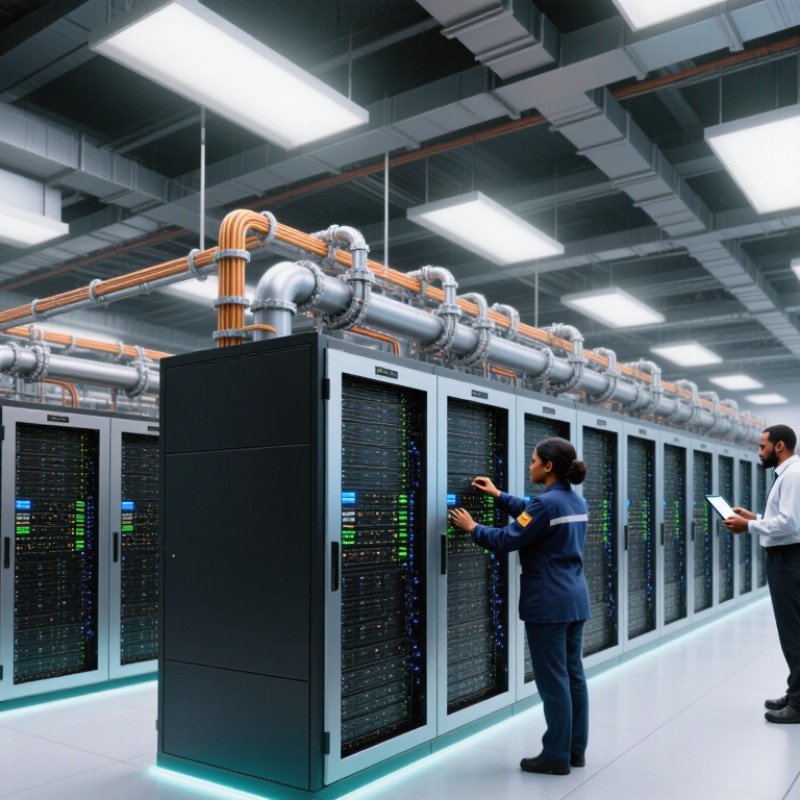
In 2026, an AI server manufacturer is more than a company assembling powerful hardware. It designs complete computing systems for demanding workloads, including model training, inference, simulation, and data analysis. Its engineers must balance accelerator performance, memory bandwidth, storage speed, network latency, and energy use. A reliable manufacturer explains these trade-offs clearly. It does not hide behind impressive specifications.
Practical experience appears in small details. Engineers test servers under sustained heat, not only during short demonstrations. They measure rack airflow, fan noise, power spikes, and recovery time after component failure. Firmware updates should be controlled and traceable. Security checks should cover the management controller, operating system, and supply chain. Technical support also matters. Buyers need installation guidance, diagnostic tools, replacement procedures, and realistic response times. Good documentation often reveals more than polished sales language.
Manufacturing quality needs evidence. Independent validation, repeatable test reports, transparent warranty terms, and regional compliance records strengthen buyer confidence. A capable manufacturer also understands different data-center conditions, from limited power capacity to high-altitude cooling challenges. Yet no supplier gets everything right. Thermal designs may perform differently after years of dust exposure, and software compatibility can lag behind new workloads. Honest manufacturers acknowledge these gaps and improve through field feedback. That attitude is not weakness. It is a practical sign of maturity.
Reliability is built over time.
It designs complete systems for training, inference, simulation, and data analysis. Performance alone is not enough. It explains trade-offs between memory, networking, cooling, and energy use. Reliable testing includes sustained heat, fan noise, power spikes, and failure recovery.
Compare accelerator quantity, memory capacity, interconnect speed, storage, PCIe layout, and network bandwidth. Check performance with similar datasets and software versions. Large numbers can mislead. Ask for written benchmark results under stated power limits.
Dense racks can produce intense heat during continuous workloads. Some systems may require liquid cooling, stronger power distribution, and careful airflow planning. Request idle, typical, and peak power readings. Cooling failures are expensive.
Request traceable components, repeatable test reports, controlled firmware updates, and clear warranty terms. Independent validation adds confidence. Review safety certifications and regional compliance records. Polished brochures are not evidence.
Support should include installation guidance, diagnostic tools, replacement procedures, and realistic response times. Confirm spare-part locations and technician coverage. Ask how failed accelerators are replaced across borders. Not in theory.
Review electrical safety, electromagnetic compatibility, restricted-substance requirements, and market-specific certifications. Export-control rules may affect advanced computing equipment and destinations. Check serial numbers, test reports, firmware controls, and customs descriptions. Independent verification remains wise.
Include electricity, cooling, software integration, maintenance, support, and possible downtime. A cheaper server may become expensive after deployment. Measure real energy use during a pilot installation. Initial assumptions can be wrong.
No. Documentation can be incomplete, outdated, or overly optimistic. Request a sample configuration, written test report, and short acceptance trial. Field conditions may expose dust, unstable power, or software compatibility problems. No checklist is perfect.
In 2026, an AI server manufacturing company is defined by more than its ability to assemble high-performance hardware. Leading manufacturers combine advanced computing architectures, accelerator support, high-speed networking, efficient cooling, reliable power management, and flexible system design to meet the demands of training, inference, data analytics, and enterprise workloads. Their platforms are built for scalability, energy efficiency, security, and long-term operational stability across different deployment environments.
For global buyers, comparing AI server manufacturers requires careful evaluation of processing capacity, memory configuration, expandability, software compatibility, lifecycle management, warranty coverage, and technical support. Purchasing decisions should also consider regional certification, import requirements, data-center standards, delivery capabilities, spare-parts availability, and after-sales service. A strong manufacturer should provide transparent specifications, configurable product options, dependable quality control, and responsive support for international customers. By assessing both technical performance and global purchasing readiness, organizations can select AI server solutions that align with current workloads while remaining adaptable to future computing needs.
